Digital accessibility training programme
Designing and delivering a blended accessibility training programme for academic and professional services staff at a large UK university.

Overview
The University of Strathclyde is a large research-intensive university in Glasgow, with over 30,000 students and 3,500 staff across four faculties - Engineering, Science, Humanities and Social Scienes, and the Business School - and central professional services.
I was appointed as Digital Accessibility Trainer in January 2024 to design and deliver the university’s first comprehensive digital accessibility training programme, supporting a wider institutional inclusion initiative aligned with the University’s 2030 strategy and its legal obligations under the Public Sector Bodies (Website and Mobile Apps) Accessibility Regulations (2018).
Challenge
Although awareness of accessibility was relatively high, many staff lacked the confidence and practical skills to apply accessibility in their day-to-day work.
Key constraints included:
A diverse audience spanning academic and professional services roles
Mixed technical confidence, from content editors to learning technologists
Limited time and capacity to retrofit existing materials
Dependence on third-party platforms with constraints around customisation
A strong culture of academic autonomy, requiring flexibility rather than prescription
Hybrid working patterns, requiring both synchronous and self-service learning options
The programme needed to be practical, respectful of context, and adaptable — not a one-size-fits-all solution.
My approach
I designed the programme using experiential learning principles, with a strong emphasis on application rather than just knowledge of compliance requirements.
Analysis
Conducted 14 stakeholder interviews across faculties and professional services to determine learning gaps
Reviewed historical accessibility audits and ongoing testing data to identify common conformance issues and trends
Completed training on key institutional systems - TerminalFour CMS and "MyPlace" Moodle - to understand capabilities and identify gaps in onboarding matierals
Developed learner personas representing the core audience: content editors, and learning technologists supporting academics
Used a survey to poll on the proposed topics and learning preferences
Design
I defined learning outcomes using Understanding, Analysing and Applying verbs from Bloom's Taxonomy to allow learners to move from awareness of digital accessibility principles and barriers, to application of content creation techniques.
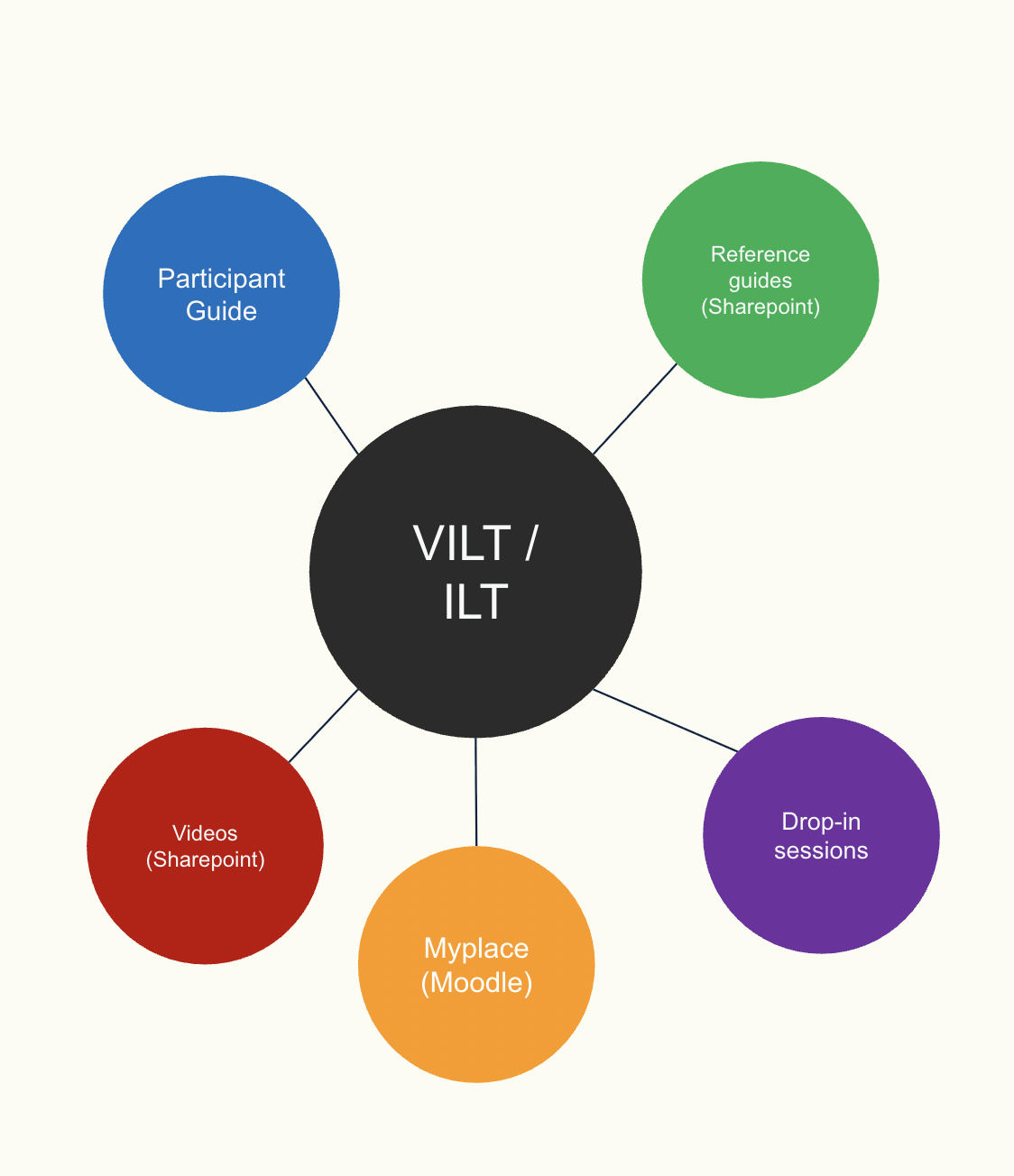
I designed a blended learning model that combined instructor-led sessions with self-paced resources, with priority given to hands-on activites, reflective exercies and actionable insights learners could apply to their work.
Sessions were structured to include each stage of Kolb's Cycle of Experiential Learning:
Concrete experience: I gave learners a new experience, such as attempting to use assistive technologies or performing a task in the guise of different accessibility personas
Reflective observation: I invited discussion and collaborative organisation of the issues encountered.
Abstract conceptulisation: I demonstrated key issues, techniques, and common pitfalls.
Active experimentation: I invited learners to apply what they'd learned to a different part of the material or invited them to create material
Depending on the session topic, some of these stages happened simultaneously or were repeated. I used break out rooms, pair shares and gallery walks to encourage learners to use the learning space and collaborate.
Development
I developed the session plans and facilitator guides for 10 distinct instructor-led sessions covering accessibility for documents, web content, e-learning and SharePoint
I created example webpages, documents, MyPlace (Moodle) classes, and SharePoint sites that learners could review and remediate during the sessions, with my support
I also produced participant guides that learners could use to capture key takeaways and reflections during some sessions.
For in-person sessions, I created A3 size print outs of web content, documents and prompts that learners could write and doodle on.
I created a SharePoint site with content accessibility guides, and produced several short videos demonstrating techniques for creating accessible content
Implementation
All courses were launched within a three-month rollout period and then delivered as business-as-usual training. Sessions were either delivered virtually over Microsoft Teams or in-person.
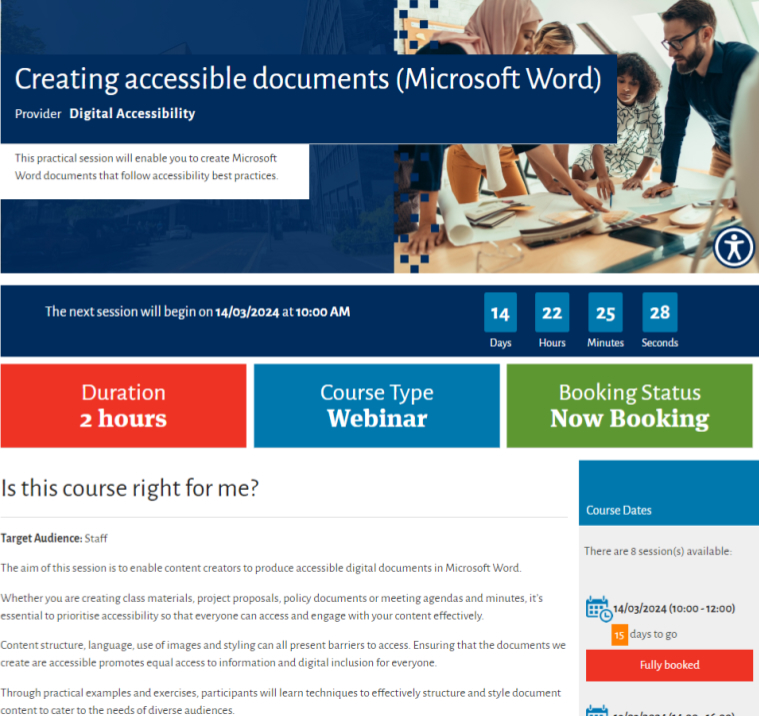
I managed sign-ups through our booking platform, using branding to give the programme a consistent identity, and advertised the courses in the campus newsletter, supplemented by a trainer interview and CPD articles.
Academic holidays and exam periods restricted sign-ups during the summer. I adapted by offering shorter, bite-sized lunch and learn sessions, and creating a SharePoint site featuring articles and video demonstrations.
Evaluation
I used pre-session questionnaires to assess learners' familiarity with the topics, and post-session questionnaires to measure how relevant the materials were to them.
Impact
Delivered training to 600+ colleagues during the initial programme launch between March and June 2024
100% of early participants reported feeling more confident and empowered to act on what they learned
Accessibility conversations shifted from 'what's required' to 'how can we do this'
Reflection
This project reinforced my belief that learning experiences works best when they:
respect learners' own experiences
realistically relate to the professional context
create a safe space for people to experiment
At times I found it challenging striking a balance between the complexity of the subject material and the limited time available. I tried to break concepts down to very specific, actionable techniques that learners could implement immediately.
The sessions I was able to run in person were among the most valuable for me as facilitator, as well as my learners, since it prompted broader discussions about policy and processes, and encouraged collaboration amongst different disciplines that don't often have the opportunity to work together.
Working in London and regularly commuting to Glasgow also demonstrated that I can make a hybrid role work. I appreciated the flexibility, though I do have a preference for working closely with colleagues in any context.
Gallery